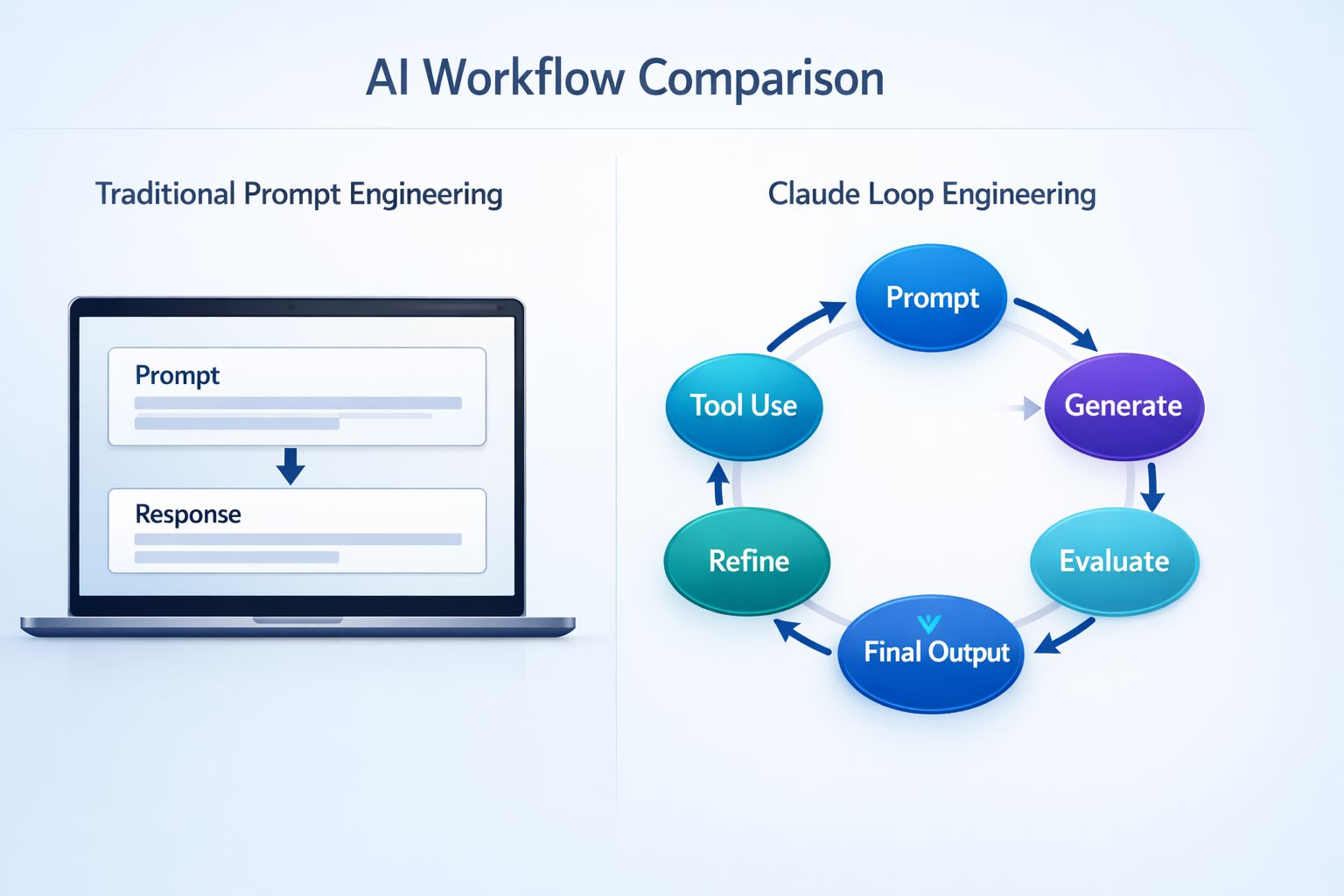
Anthropic’s Claude loop engineering is not just a smarter way to write prompts. It is a broader way to design AI workflows where Claude can generate, review, refine, and sometimes use tools across multiple steps before reaching a final answer.
Traditional prompt engineering, by contrast, is about improving the quality of a single model response. The difference matters because many teams still treat prompt quality as the full solution, when in practice reliable AI systems often need feedback loops, validation, and controlled iteration.
Why this distinction matters
Prompt engineering is still the foundation of any good AI interaction. A well-written prompt gives the model a clear task, the right context, the preferred format, and examples when needed.
But loop engineering starts where prompt engineering starts to run out of road. Instead of assuming one carefully written instruction will solve the problem, it assumes the first output may need checking, correction, or expansion before it is actually useful in a production workflow.
This is why loop engineering is especially relevant for AI agents, coding systems, research assistants, and other applications where the model must do more than simply respond once.
Traditional prompt engineering
Traditional prompt engineering focuses on one main objective: getting the best possible output from one request. The work usually involves refining instructions, adding structure, giving examples, specifying tone, and guiding the model toward the desired format.
This approach works well for bounded tasks. If the goal is to summarize an article, rewrite a paragraph, classify text, generate a draft, or extract structured information, a strong prompt is often enough.
It is fast, cost-effective, and relatively easy to test. Teams can compare prompt versions, adjust wording, and improve results without building much surrounding infrastructure.
Claude loop engineering
Claude loop engineering treats the model as part of a larger system rather than as a one-time text generator. The model produces an output, that output is evaluated, and the next step depends on what happened in the previous one.
In a loop, Claude may draft a response, review evidence, call a tool, inspect the result, revise the answer, and repeat that cycle until it meets a stopping rule. This makes the workflow more resilient because quality is not dependent on one perfect prompt.
It also changes the role of the developer. Instead of only writing better prompts, the developer designs the workflow around the model, including decision points, evaluation checks, tool boundaries, and fallback logic.
The real difference
The easiest way to understand the difference is this: traditional prompt engineering optimizes a single interaction, while Claude loop engineering optimizes the whole process.
With traditional prompting, most of the intelligence is packed into the instruction itself. With loop engineering, intelligence is distributed across the prompt, the workflow, the checks, and the logic that decides whether Claude should continue, revise, or stop.
Traditional prompting is best when the path is clear from the beginning. Loop engineering is better when the task unfolds step by step and the system needs to adapt based on new information.
Traditional prompting usually keeps state inside the current conversation window. Loop engineering may carry forward intermediate outputs, tool results, retrieval context, and evaluator feedback across several turns.
Traditional prompting often handles failure by asking the model again with a revised prompt. Loop engineering handles failure more systematically by feeding back evaluation signals and routing the model through another pass.
Where loop engineering is stronger
Claude loop engineering becomes more valuable when the task is open-ended, uncertain, or operationally important. This includes areas such as AI-assisted coding, document analysis, agent workflows, research pipelines, or automation that interacts with external systems.
In these cases, the first answer is often not enough. The model may need to inspect retrieved information, verify whether the output meets criteria, recover from mistakes, or decide what to do after a tool returns unexpected data.
That is where loops outperform one-shot prompting. They introduce a mechanism for controlled correction instead of relying entirely on initial prompt precision.
Where traditional prompting still wins
Traditional prompt engineering should not be seen as outdated. In fact, Anthropic’s own guidance suggests starting with the simplest workable approach and only adding agentic complexity when it clearly improves the result.
That advice is important because loops increase cost, latency, and engineering overhead. If a task can be solved with one strong prompt, adding a multi-step loop can make the system slower and harder to maintain without enough benefit.
For content drafting, summarization, rewriting, extraction, and many internal productivity tasks, traditional prompting is still the practical first choice.
What technical teams should take away
The practical lesson is not that loop engineering replaces prompt engineering. It builds on it.
A weak prompt inside a loop still creates a weak system. But a strong prompt inside a well-designed loop can power applications that are far more reliable than one-shot prompting alone.
For technical teams, the right question is not which one is better in absolute terms. The better question is whether the task needs a good answer once, or a dependable process that can inspect, correct, and improve itself before delivering the result.
References
- Anthropic: Building Effective AI Agents
- Claude Docs: Prompt engineering overview
- Anthropic: Prompt engineering for business performance
Hashtags
#AI #Anthropic #Claude #PromptEngineering #LoopEngineering #AIAgents #LLM #SoftwareDevelopment #LinkedInCreators