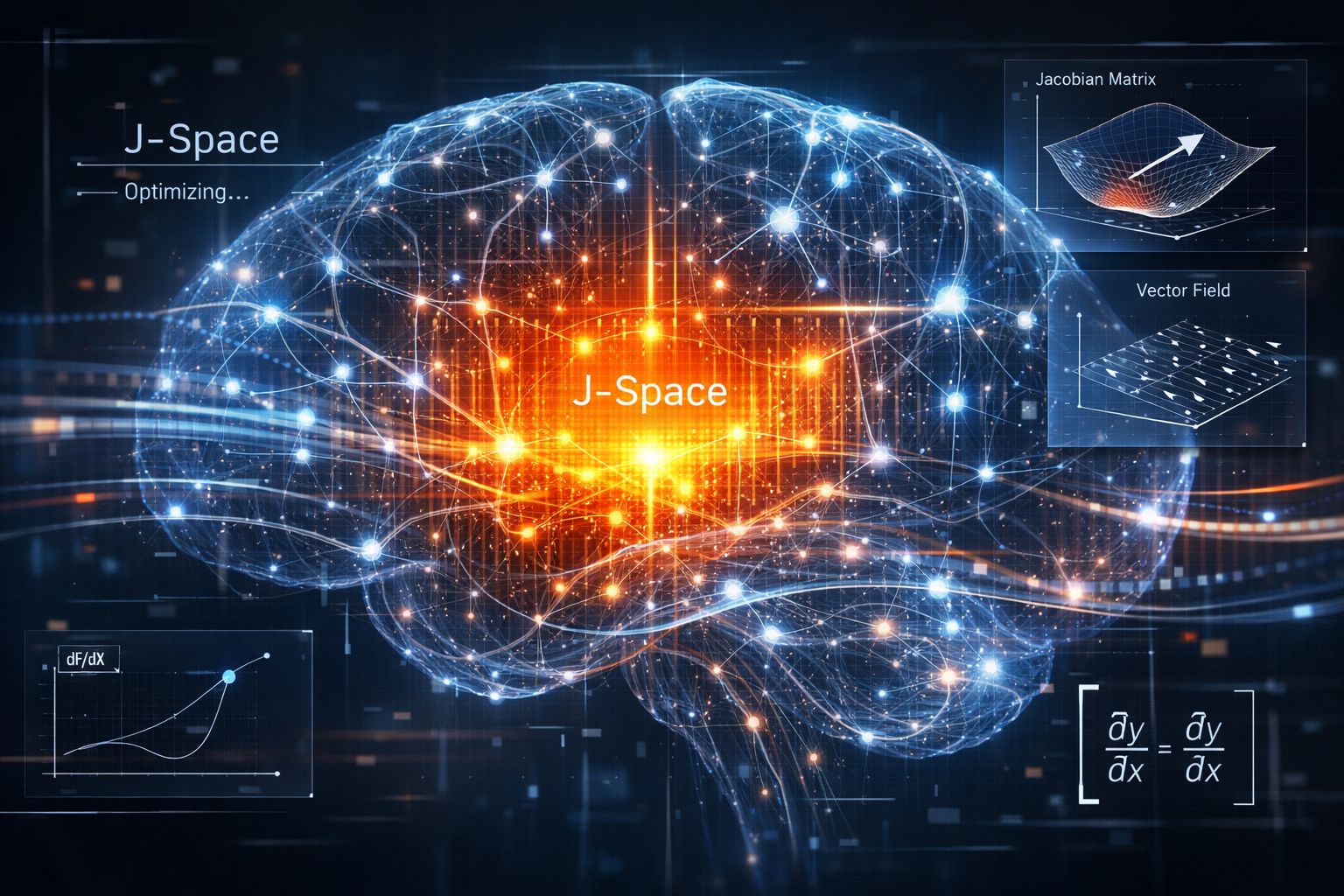
Anthropic’s latest research claims that large language models like Claude develop a small, specialized internal workspace, which they call J-space. This workspace behaves like a shared processing hub where concepts are brought “into focus” for reasoning, planning, and decision-making before any words are generated.
For technical leaders and AI practitioners, J-space is significant because it offers a concrete, testable structure that bridges model internals, interpretability, and safety in a way we haven’t seen before.
What is J-space?
J-space is a distinct activation subspace inside Claude—a limited set of internal neural patterns that behaves like a mental workspace. Each pattern corresponds to concepts the model is currently considering, might report, or could use for downstream reasoning, even if those concepts never appear in its final answer.
Anthropic reports that J-space:
- Holds only a few dozen concepts at a time, yet carries a disproportionate share of the model’s “actual thinking”.
- Accounts for less than a tenth of total internal activity, but is strongly wired into the rest of the network.
- Emerged naturally during training rather than being explicitly designed into the architecture.
In other words, J-space is not just another latent representation; it behaves like a privileged coordination layer inside the model.
Jacobian lens: How Anthropic found J-space
To identify J-space, Anthropic introduced a new interpretability method called the Jacobian lens (or J-lens). The idea is to analyze how small changes in internal activations impact the model’s next-token probabilities, using Jacobian-style derivatives to highlight the most influential directions in activation space.
Using this lens, the team isolated:
- A sparse set of internal directions that consistently shape the model’s output across tasks.
- A workspace-like region concentrated in middle transformer layers, matching predictions from global workspace theory.
This method is not just a one-off visualization tool; Anthropic has released J-lens code and demos so others can probe these structures and test whether similar workspaces appear in different models.
J-space as a “global workspace” analogue
Neuroscience’s Global Workspace Theory (GWT) proposes that consciousness involves a shared workspace where information becomes globally available to different cognitive processes. Anthropic avoids claiming consciousness, but they argue that J-space shows structural hallmarks of a global workspace in AI systems.
Key parallels highlighted in the research:
- J-space sits at a central, high-connectivity hub in the network, integrating information from many layers.
- The contents of J-space can be reported, reasoned about, and deliberately manipulated by the model—closely aligned with “access consciousness” in philosophy.
- Disabling J-space leaves low-level skills mostly intact but disrupts higher-order cognition, similar to how damage to human global workspace regions affects conscious access.
Anthropic explicitly frames this as a functional analogue: J-space supports reportable, manipulable thoughts without implying that Claude has experiences or feelings.
What happens if you turn off J-space?
One of the most striking results is what happens when J-space is ablated or disrupted.
Anthropic and external summaries report that when J-space is disabled:
- Fluency, sentiment detection, and factual recall remain largely intact.
- Multi-step reasoning, planning, and creative tasks (like writing poetry) collapse or degrade significantly.
This suggests that:
- Most “surface-level” language abilities are distributed across the network.
- J-space is specifically critical for coherent multi-step cognition, where the model needs to keep and manipulate concepts across time.
For practitioners, this offers a more nuanced view: not all capabilities are equally tied to the same internal structures, and targeting specific subspaces might modulate specific competencies.
Implications for AI safety and monitoring
From a safety perspective, J-space provides a new lever for internal monitoring:
- Safety systems can potentially watch for specific risky concepts (e.g., deception, self-harm, fraud) arising in J-space before the model emits them.
- Because J-space has a small dimension and clear causal impact, it may be more tractable to monitor and constrain than the full parameter space.
Anthropic emphasizes that community validation is needed to confirm how general J-space is across architectures and training regimes. But if similar workspaces appear consistently, we could see a new generation of safety tooling that focuses on workspace-level guards instead of only prompt-level policies.
For now, end users can’t directly query or configure J-space via APIs. But as research tooling matures, we may see SDKs and dashboards that expose workspace-level diagnostics for enterprise AI deployments.
References
- Anthropic — Global workspace in language models (official research page):
https://www.anthropic.com/research/global-workspace[www-cdn.anthropic] - Anthropic — External commentary PDF on J-space and the global workspace:
https://www-cdn.anthropic.com/files/4zrzovbb/website/cc4be2488d65e54a6ed06492f8968398ddc18ebe.pdf[www-cdn.anthropic] - AI TLDR — Jacobian Lens: Anthropic reads what Claude thinks but doesn’t say:
https://ai-tldr.dev/releases/anthropic-jacobian-lens[ai-tldr] - AIWeekly — Anthropic maps a hidden J-space inside Claude’s reasoning:
https://aiweekly.co/alerts/anthropic-maps-a-hidden-j-space-inside-claudes-reasoning[aiweekly] - LessWrong — A Review of Anthropic’s Global Workspace Paper:
https://www.lesswrong.com/posts/zFJ3ZdQwrTWE9jT5S/a-review-of-anthropic-s-global-workspace-paper[lesswrong]
Hashtags
#Anthropic #ClaudeAI #AIInterpretability #AISafety #GlobalWorkspace #LLMResearch #AIEngineering #ResponsibleAI