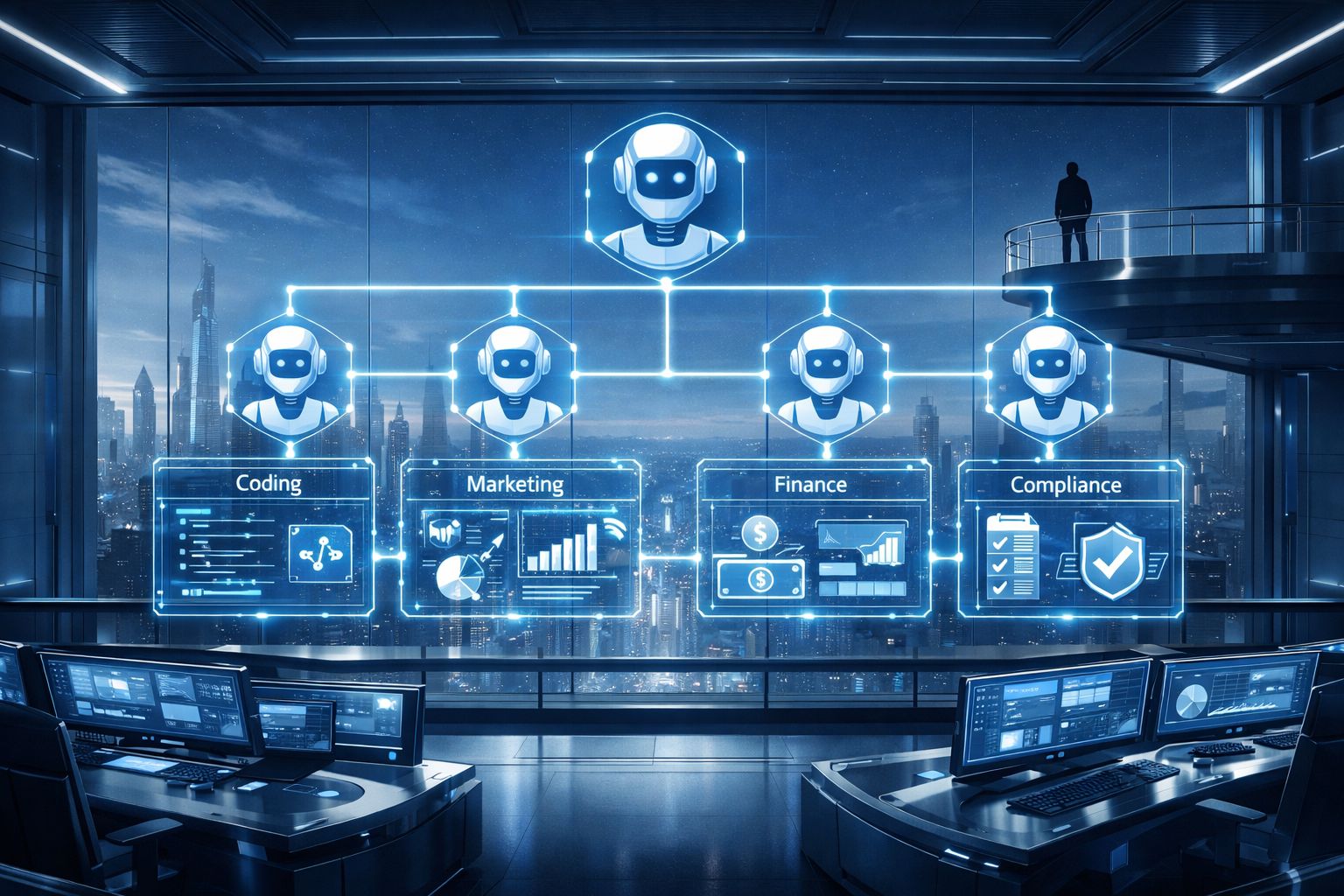
Zero-person companies and non-human enterprises are no longer science fiction—they’re emerging from real experiments, frameworks, and governance models.
1. From “company of people” to “company of agents”
The idea of a company has always been synonymous with people: founders, employees, teams, and org charts.
Agentic AI is quietly breaking that assumption by turning workflows, decisions, and even coordination into software that can run with minimal human presence.
What started as solo founders using AI to punch above their weight is evolving into architectures where agents handle most operational work and humans focus on strategy, governance, and exceptional cases.
2. Industry signals: zero-person companies as a serious design pattern
Business and tech media now treat “zero-person” or “zero-employee” companies as a plausible design pattern rather than a science-fiction trope.
Analyses of 0-person startups and 0-employee businesses show founders assembling AI agents for product development, marketing, support, and operations, while outsourcing specialized human expertise on demand instead of hiring full-time teams.
These pieces converge on a consistent narrative: AI agents become the operating layer of the firm, and modern infrastructure (APIs, cloud, crypto) forms the financial and coordination layer, allowing companies to run 24×7 with extremely lean staffing.
3. Tooling: company-as-code with agent platforms
The biggest shift for practitioners is that we now have tooling explicitly designed to build and run “zero-human” or “agent-first” organizations.
Agent platforms and orchestration frameworks let you define roles (research, coding, marketing, compliance), assign them to agents, connect them to tools, and coordinate them through structured workflows.
Products that manage agent “teams” with budgets, goals, and governance effectively turn the org chart into configuration: you don’t just automate tasks, you codify responsibilities and hand them to agents.
At the framework level, multi-agent libraries are being used in experiments to build companies that have no employees on paper, but do have an ecosystem of agents that collaborate, escalate, and learn over time.
4. Research and governance: the rise of the non-human enterprise
Management research has started to treat agentic organizations as a serious subject, introducing operating models for enterprises where autonomous agents sit inside core decision loops.
These models focus less on model performance and more on governance: who can create agents, what they can access, how they are monitored, when human override is mandatory, and how accountability works when an agent makes a mistake.
The emerging consensus is that non-human enterprises need layered governance: policy at the top, orchestration and controls in the middle, and detailed logging and auditing at the bottom.
5. Enterprise practice: systems, not standalone models
Large vendors and enterprises increasingly emphasize that AI value comes from systems, not standalone models.
Identity, security, compliance, and observability are being built into agent platforms from the start, so that agents inherit the same trust and policy surface as other enterprise workloads.
Internal case studies talk about being “customer zero” for agentic workplaces: using agents across internal processes, learning where they fail, and updating architecture and policies accordingly.
This mindset aligns directly with the non-human enterprise idea: companies where agents are first-class operational actors must be treated as systems of identity, access, and control, not as chatbots with extra features.
6. What this means for builders and professionals
If zero-person companies and non-human enterprises are the trajectory, the skill profile for professionals will change.
Developers and architects will increasingly design agent workflows, encode organizational logic in code, and work closely with governance teams to keep agents aligned with business and regulatory constraints.
Product and operations leaders will spend more time on “who does what” at the system level—human vs agent—and less time on managing large headcount.
Practically, three capabilities become critical:
- Thinking in systems: seeing the company as an architecture of agents, tools, and policies.
- Designing agentic workflows: decomposing goals into tasks and assigning them to agents with clear contracts and boundaries.
- Building governance into the stack: identity, permissions, audit trails, and escalation paths that keep humans meaningfully in control.
The non-human enterprise won’t arrive overnight, and most companies will remain hybrid for a long time.
But as industry, tooling, and research all converge on this pattern, it’s increasingly likely that the companies you build—and work for—will look less like org charts of people and more like orchestrated networks of agents, with humans at the strategic and ethical helm.
References
#ArtificialIntelligence #AIAgents #ZeroPersonCompany #NonHumanEnterprise #CompanyAsCode #AgenticAI #FutureOfWork #EnterpriseAI #Automation