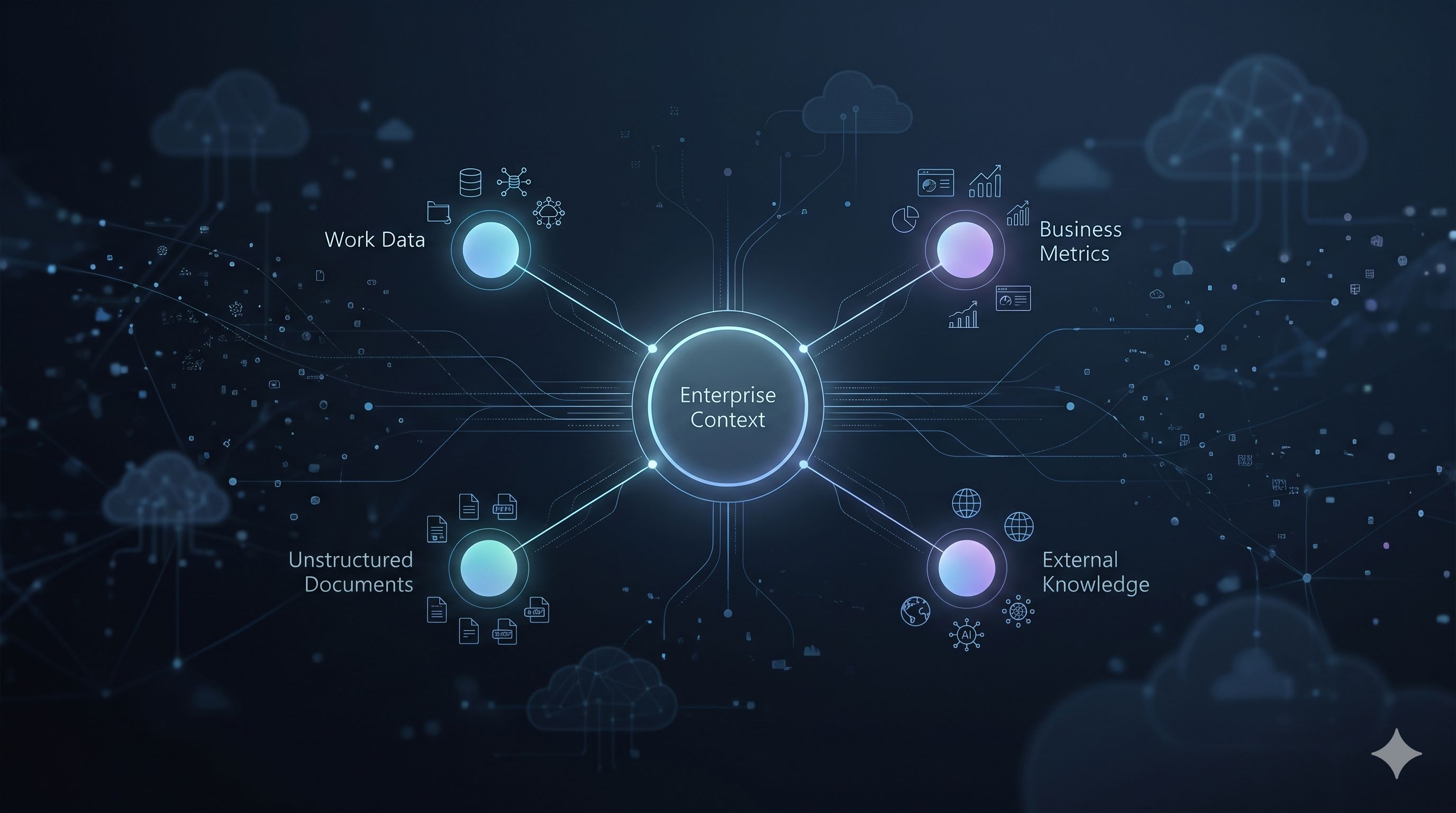
Microsoft has announced Microsoft IQ, a new enterprise context-management platform designed to help AI agents understand an organization’s data, processes, expertise, and tools. Announced at Microsoft Ignite 2026 on November 17, the platform is now generally available.
The core idea is straightforward: enterprise AI is only as useful as the context it can access. An agent may be capable of reasoning, writing, and taking action, but it still needs to know which customer record matters, which policy applies, which data source is authoritative, and which workflow should be followed. Microsoft IQ is intended to provide that context in a governed and reusable way.
Why context matters
Most organizations already have substantial knowledge spread across documents, applications, databases, collaboration tools, and business systems. The challenge is that this knowledge is often fragmented and difficult for AI agents to use consistently.
Microsoft IQ aims to address that gap by turning organizational context into an asset. Instead of building custom context pipelines for every agent, teams can reuse the relevant data, skills, tools, and business knowledge across scenarios. Microsoft describes this as helping organizations apply successful patterns from one workflow to future agents and business processes.
The building blocks
Microsoft IQ brings together four context capabilities:
- Work IQ provides work-related data and the context behind decisions. It supports richer context, actions, and governance controls for Copilot and agents.
- Fabric IQ connects enterprise data with business meaning, trusted metrics, and operational context. It combines OneLake data, Power BI semantic models, and ontologies.
- Foundry IQ activates unstructured content for applications and agentic retrieval. Microsoft says it includes an enterprise knowledge graph across an organization’s unstructured and application data.
- Web IQ adds real-world information to complement internal enterprise context.
Together, these components are designed to give agents both internal business context and relevant external information. That combination can be important for scenarios such as customer support, contract review, sales planning, incident response, or operational reporting.
Business plugins
A central part of Microsoft IQ is the concept of business plugins. These packages organize an organization’s context, expertise, skills, tools, and agents around a specific business scenario.
For example, an organization could create a business plugin for supplier onboarding. It could bring together procurement policies, supplier records, approval workflows, relevant documents, and specialized agents. Another team could then reuse that plugin rather than rebuilding the same context from scratch.
This approach shifts the focus from individual AI features to reusable enterprise building blocks. It may reduce duplication, but its effectiveness will depend on how well organizations define ownership, permissions, data quality, and governance for each plugin.
Continuous improvement
Microsoft IQ also incorporates capabilities from Microsoft Foundry to connect evaluations and production insights to agent optimization and model training. Microsoft describes this as helping applications and agents improve after deployment as models, tools, and business needs evolve.
In practice, this means organizations can use feedback from real usage to refine agents over time. That is important because enterprise AI systems are not static: business rules change, data sources change, and user expectations evolve.
Availability and integration
Microsoft says Microsoft IQ is generally available and is built on products organizations already use. It requires no new SKU or subscription. Its context capabilities are generally available across Microsoft Copilot, GitHub Copilot, Microsoft Foundry, and any agent harness that supports MCP.
Fabric IQ integrations extend its data context into Excel, GitHub Copilot, ChatGPT, and Claude. Microsoft notes that some of these integrations are generally available, while others remain in preview.
For technical leaders, Microsoft IQ is best understood as a context and reuse layer—not a standalone AI model. Its value depends on the quality of the underlying data, the accuracy of semantic models, the clarity of business rules, and the strength of access controls.
Organizations evaluating it should start with a bounded use case, identify authoritative data sources, define permissions and approval points, and measure whether the agent produces better outcomes than the existing process. Microsoft IQ may simplify context reuse, but it does not remove the need for sound data governance and responsible AI practices.
References